
Uncategorized
January 28, 2025
Expert know-how, a network of contacts, managed internal processes and, of course, a paying customer. When you …
We live in an exciting world of computer technology! But it’s not just for long-distance communication anymore. It can forecast the weather, analyze transport networks, simulate complex chemical processes, or discover new galaxies. These once incredible things are made possible by the complex computational operations performed by supercomputers. But do you know how they differ from a quantum computer and how you can use them for your business?
We can no longer imagine a day without the presence of smart devices. Phones accompany us every step of the way, watches measure our vital signs, and no office can lack a quality computer. But among all the devices available, there are some that stand out above the rest in terms of performance, and these are supercomputers. Their potential is used not only by scientists but also by entrepreneurs, for example in the field of computationally demanding modelling, simulations, or advanced data analysis.
We can no longer imagine a day without the presence of smart devices. Phones accompany us every step of the way, watches measure our vital signs, and no office can lack a quality computer. But among all the devices available, there are some that stand out above the rest in terms of performance, and these are supercomputers. Their potential is used not only by scientists but also by entrepreneurs, for example in the field of computationally demanding modelling, simulations, or advanced data analysis.
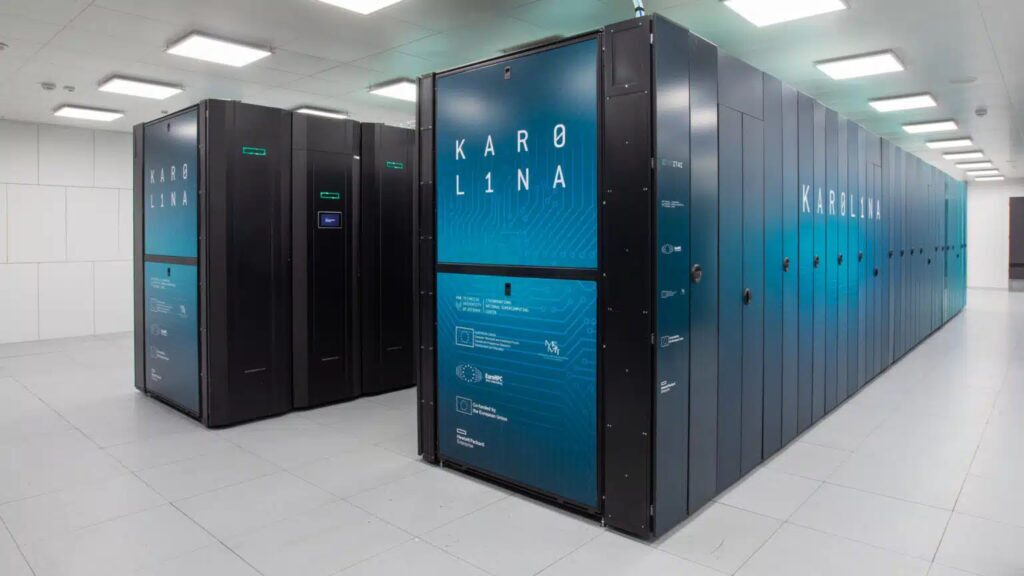
We don’t have to go far for a concrete example. Supercomputers can be found in the National Supercomputing Center IT4Innovations at the VŠB – Technical University of Ostrava, which will soon expand with a quantum computer. The services of the center are used by many companies, for example to implement a system for intelligent identification of air pollution sources, realistic architectural visualizations, creation of 3D models, production planning, or medical image processing. Our colleague Marek Lampart, an expert in quantum computing, also works at IT4Innovations, which is part of the Ostrava T-Park. Together with him, we will now NVIDIA DGX-2, Barbora and Karolina
These are not the names of Elon Musk’s children, as it might seem at first glance. In fact, they are the names of the high-performance systems that help IT4Innovations solve very complicated tasks in a short time. Because of their high computing power, which is completely unattainable for ordinary computers, they are used by the scientific community from the Czech Republic and abroad, as well as by representatives from industry. Thanks to their presence, Ostrava is increasingly becoming a sought-after technological hub for innovation and research.
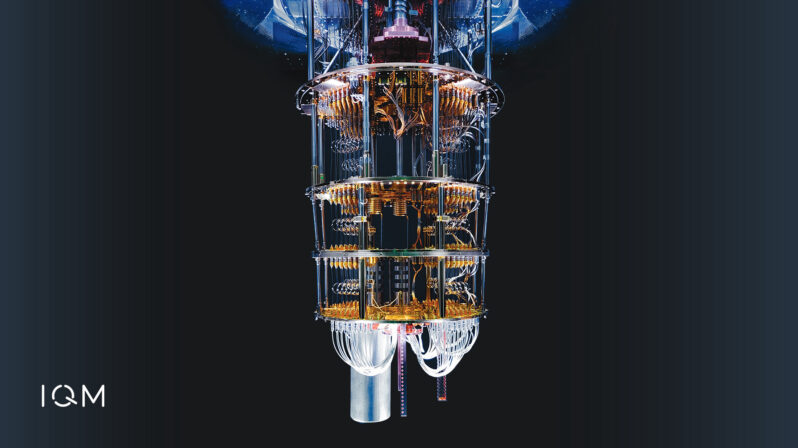
This status will soon be supported by the very first installation of one of six European quantum computers in the Czech Republic, namely from IQM Quantum Computers. This complex apparatus, costing around 165 million Czech crowns, could start a revolution in solving really tough challenges. But first things first. What makes these computers different?
A short lesson in computer technology
First of all, a supercomputer and a quantum computer are two very different kinds of devices that process information in different ways. You can think of a supercomputer as a big noisy cabinet full of shelves of cables and computing units (nodes) made up of processors. These nodes are interconnected and achieve incredible aggregate performance thanks to the network they create together. The computing power of supercomputers is calculated in FLOPS, or the number of elementary floating-point operations per second. They use a binary system of ones and zeros, where the basic unit of information is a bit that takes on only one of the opposite values of one or zero at any time.
And just that or, is important here. In the case of quantum computers, performance is measured not only in the number of quantum bits (called qubits), which can have values of 0, 1, and everything in between, and both values at the same time, but also in their precision and connectivity. And that’s even though they are opposite! (Remind you of Schrödinger’s cat? Then you’re thinking correctly.) It’s like having the lights at home on and off at the same time. It seems inconceivable, doesn’t it? And that’s exactly the basic principle of quantum mechanics, it’s called superposition. What’s more, the Ostrava quantum computer will have a size comparable to an adult human and a sleek design with a star topology.
Of course, there are far more differences, but this is enough for a basic understanding of the different principles of their operation.

Earlier in the finish, but with a higher error rate
It might seem that the rise of quantum physics heralds the demise of supercomputers and their replacement by quantum computers. Well, that’s not the case. Quantum computers are not suitable for all types of tasks. In Ostrava, a quantum computer will be connected to the Karolina supercomputer and together they will take the role of a hybrid infrastructure that will efficiently handle algorithm optimization, data preparation and processing. The resulting hybrid system will thus be able to be used not only for classic and quantum computations, but mainly to exploit the synergy potential of both systems.
Then the question also arises, why do we need quantum computers when supercomputers are getting faster and can do so much? Well, they’re not quite enough for everything. We can already construct problems that would take centuries to solve on the most powerful classic supercomputers, but we will be able to calculate them quantumly in a fraction of the time.
In addition, the dynamic pace at which we live brings an almost constant need to develop new and novel materials, replacing non-renewable resources with renewable ones, while the ageing population brings the challenge of the need to discover new medicines. In short, there are still a huge number of currently intractable challenges that scientists cannot yet calculate. Quantum computers hold the promise of changing that in the future. Although quantum computing is still in its infancy, and high error rates must be taken into account, forecasts for the development of a truly powerful quantum computer are very promising, saying that humankind will achieve quantum advantage in 2033 or even earlier.
Science, research, business. Where do computers fit in?
The work with quantum computers is still rather at the experimental level. They are mainly used in scientific fields where it is necessary to solve such complex operations that even supercomputers encounter their limits. Examples of good practice show that they work well especially in the case of optimization. Supercomputers, which provide much more accurate results, are used for analyzing large-scale data, simulations, testing new products, or planning transport routes.
Did you know that supercomputers have helped, for example, the rapid development of artificial intelligence that we are experiencing right now? That’s because they can handle the large volumes of data that AI uses. Quantum computers on the other hand speed up the training of individual AI models.
However, the use of both types of equipment is very wide. Supercomputers are nowadays quite commonly used in financial markets, where they help to identify trends and possible risks, in cryptography for the development of cryptographic methods that can resist external attacks, in the logistics of goods and the planning of transport routes with regard to their security, in the automotive industry they can simulate, for example, the behavior of new cars in a crash, even when they are not yet in production, in medicine, where through simulations they contribute to the development of medicines, in energy, meteorology…
For example, do you have the Aladin weather forecast app from the Czech Hydrometeorological Institute on your phone? In that case, you also use the services of a supercomputer, which solves complex equations that allow the Aladin numerical model to work properly.
In all these areas, quantum algorithms are being developed that aim to dramatically speed up computation compared to classic supercomputers, preferably exponentially. Such algorithms will make it possible, for example, to break current encryption in real time, to simulate quantum phenomena, to discover new medicines, or to find and optimize the best investment strategies, and many other things that current supercomputers would take hours, days and sometimes years to calculate.
Want to learn more about the use of quantum computers? In spring 2025, Marek Lampart will publish the Atlas of Quantum Computing, in which he describes examples of good practice in nearly a dozen industries!
Almost anyone can compute in the IT4Innovation supercomputing center, not only academics but also industrial companies. Academics can bid for computing time through open calls and businesses can buy it at an affordable price. In the case of the quantum computer, the situation will be similar, and its performance will be available on similar terms.
Enhancing international cooperation
The quantum computer will be set up in Ostrava by the LUMI-Q consortium, which links nine European countries (Czechia, Finland, Sweden, Norway, Denmark, Poland, the Netherlands, Germany, and Belgium) and their research institutions under the EuroHPC joint venture. The aim of the initiative is to build a network of supercomputers complemented by quantum technology in cooperation with consortia and EU Member States. The hybrid system that will be built in Ostrava will be linked to other supercomputers in Europe and will serve all the countries involved.
LUMI-Q builds its activities on the classic computing background of the LUMI consortium. And LUMI is also the basis for the LUMI AI Factory project, which was one of the seven winners of the EuroHPC call for AI Factories to enable the development and deployment of AI tools across industry and society in Europe. IT4Innovations is involved in the project for the Czech Republic.
Part of the updated RIS MSR
Quantum technologies have great potential for innovation, data security, and modelling of complex systems. In the Moravian-Silesian Region, we are aware of this, which is why quantum technologies and computing are among the emerging domains of the MSR Regional Innovation Strategy. But more about that next time.
This article was written with the support of the EDIH OVA project (EDIH Ostrava), which is funded by the European Union, the Digital Europe Program (ID: 101083551) and within the NEXT GENERATION EU (ID: EDIH1.5.01.4).

Expert know-how, a network of contacts, managed internal processes and, of course, a paying customer. When you …
Czech startups made a splash on the international stage in Poland! In a competition of more than 120 projects from ...

The transformation of the Moravian-Silesian Region has been a frequently discussed topic in recent years. Do you …


